
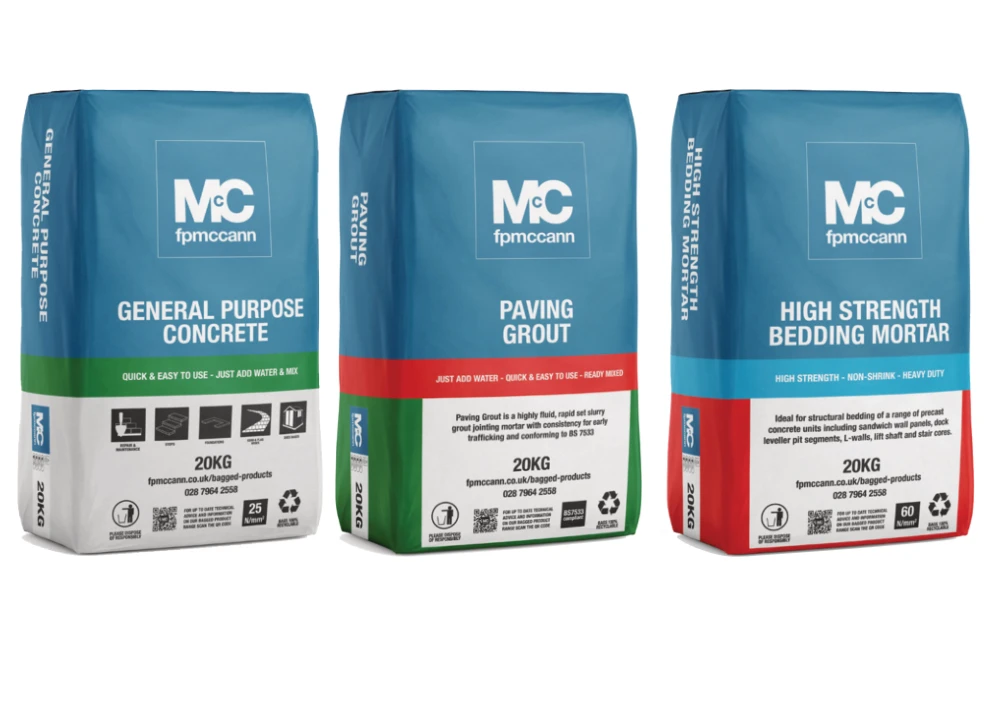
Choose bagged concrete for suitable concrete pours and repairs, mortar for its specified masonry or bedding application, and grout for the particular joints or voids it is designed to fill. These materials are not interchangeable. Start with the job, then check strength, application depth, working time and mixing requirements.
Bagged concrete contains a pre-blended mix for concreting work. Masonry mortar is formulated for tasks such as laying bricks and blocks or pointing compatible masonry. Specialist bedding mortars support particular components or paving systems. Grout can mean a paving jointing product or a technical construction grout, each with a different specification.
A product described as high strength is not automatically the right choice for every job. The material must suit the substrate, exposure, application thickness and performance specified for the work. Existing or historic masonry, for example, needs an assessment of mortar compatibility rather than simply choosing the strongest available mix.
Product | Main selection route |
General Purpose Concrete | Suitable paths, steps, bases and concrete repairs |
High Performance Concrete | Concrete work requiring its declared performance |
Rapid Set Backfill Concrete | Specified access cover and gully reinstatement, deeper repairs and commercial post work |
General Purpose Mortar | Suitable brickwork, blockwork, pointing and masonry repairs |
High Strength Bedding Mortar | Specified bedding and gap packing for precast concrete units |
Rapid Set Bedding Mortar | Access cover frames, highway ironwork and suitable rapid bedding work |
Paving Bedding Mortar | The bedding layer beneath suitable paving units |
Paving Grout | Jointing compatible paving in a rigid bound construction |
High Performance Grout | Specified construction void filling and grouting applications |
General Purpose Concrete is listed for paths, steps, shed bases and general repairs. High Performance Concrete provides another option where its declared performance meets the project requirements. For foundations or structural work, confirm the complete specification before choosing either product.
Rapid Set Backfill Concrete addresses different work, including access cover and gully reinstatement and thick-section repairs. Its short application window means preparation and placement need to be organised before mixing. Do not assume the same handling time as a general purpose concrete.
General Purpose Mortar is the starting point for suitable brick and block laying, pointing and patching. Check its compatibility with the masonry and project requirements, particularly for repairs to existing work.
High Strength Bedding Mortar is intended for specified precast concrete bedding and gap packing. Rapid Set Bedding Mortar serves applications such as access cover frames and highway ironwork where early strength is required. Neither should be treated as a general substitute for masonry mortar.
Paving Bedding Mortar forms the bed beneath suitable stone, clay, concrete or porcelain paving. Paving Grout fills joints between compatible paving units. Selecting one does not remove the need for the other layers required by the paving design.
Check the paving type, base, bedding depth, joint dimensions, drainage and intended traffic as a complete system. Follow the paving bedding instructions for priming and bonding. Do not use a paving jointing grout as a replacement for the bedding layer or assume a bound system suits every paving installation.
High Performance Grout is a cementitious construction grout for its specified void filling and grouting applications. Its water allowance depends on the required preparation, such as dry packing, trowelling or high-flow use. This is a different selection from paving joint grout.
For structural or precision work, use the specified product and application method. Adding water outside the stated limits to make a grout flow more easily can compromise the intended result.
Selecting a suitable bagged material does not automatically establish compatibility with a particular mixer. Check the product’s prescribed equipment, mixing duration and water allowance. Where continuous mixing is proposed, obtain confirmation for the exact material and application rather than assuming every concrete, mortar or grout can be mixed that way.
Browse the Bagged Materials range for individual technical details and available product documents. If the choice is unclear, contact the team with the application, required thickness, quantity and project specification.
We use essential technologies to make this website work. With your permission, we would also like to measure how people use it and display third-party content. The website will still work if you refuse optional technologies.