
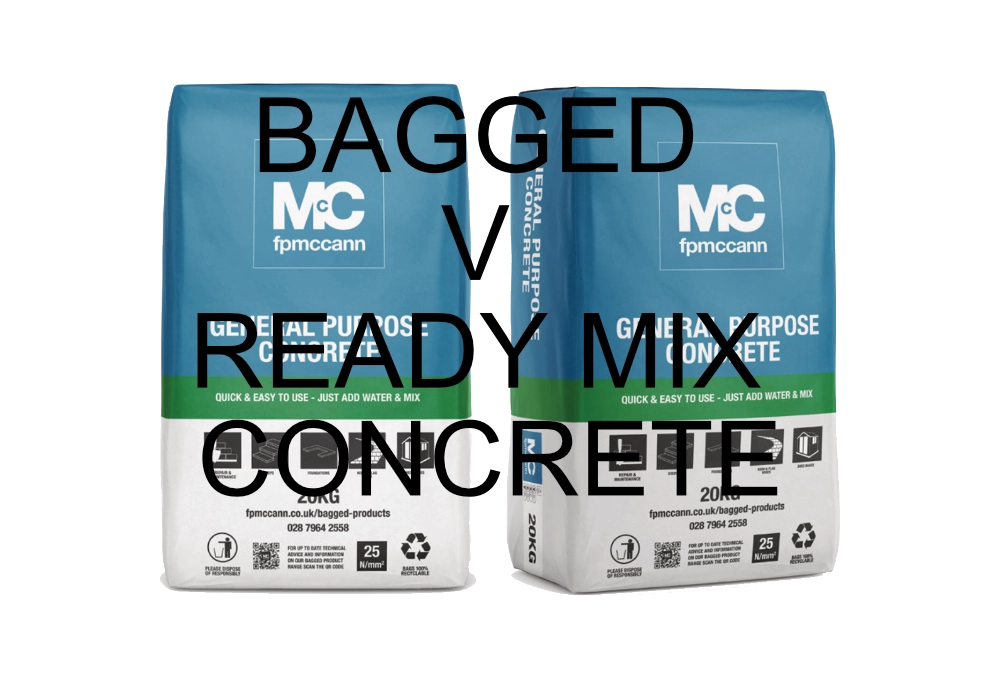
Bagged concrete can suit smaller pours, phased work and projects where material must be carried through restricted access. Ready-mix delivery can suit larger pours where the site and crew are ready to receive fresh concrete. Compare the specified concrete, total volume, access and complete job cost before deciding.
In this guide, bagged concrete means a dry, pre-blended concrete mix supplied in bags and mixed with water on site. Ready-mix delivery means fresh concrete supplied by a concrete delivery service. Some suppliers also offer volumetric mixing at the delivery point; ask what service and charging arrangement is being quoted.
A bag of cement alone is not the same as a complete bagged concrete mix. Concrete also needs the appropriate aggregates and water. Check that you are comparing complete mixes suitable for the work, rather than comparing a finished concrete product with one ingredient.
Consideration | Bagged concrete mixed on site | Fresh concrete delivery |
Quantity | Mix bag quantities as needed | Arrange the required volume with the supplier |
Site access | Plan the route for bags, equipment and mixed concrete | Check vehicle access and the discharge or pumping route |
Timing | Prepare batches within the product’s working time | Coordinate delivery, crew and placement |
Labour | Include bag handling, mixing and transport | Include discharge, transport, placement and finishing |
Storage | Provide protected dry storage for unused bags | Receive and place fresh material within supplier guidance |
Small paths, steps, bases and local repairs may need modest quantities of concrete. A bagged product lets you plan material in manageable units and keep unopened bags dry until required. This can help when several separate repairs are completed at different times.
Restricted access is another consideration. Bags may be moved through a side passage or into a rear garden, but assess the handling route and lifting demands before committing. You still need room for mixing, water, tools and moving the wet concrete to its final position.
Review General Purpose Concrete for suitable everyday applications. Where the project calls for its declared performance, review High Performance Concrete. Strength is one part of selection; the product must also meet the other requirements of the work.
As the required volume increases, the number of bags, mixing time and handling can become substantial. A ready-mix quotation gives you another way to assess the job. Ask about the specified mix, delivered volume, vehicle requirements, discharge arrangements and any waiting, minimum-load or additional charges that apply.
Restricted vehicle access does not automatically rule out delivery. Ask whether a concrete pump or another suitable placing arrangement can reach the work, and include that cost in the comparison. Equally, a convenient delivery point does not remove the need for a crew that can place and finish the concrete in time.
For a rectangular pour, multiply length by width by depth, with all measurements in metres. A path 4 m long, 0.5 m wide and 0.1 m deep requires 0.20 m³ before allowing for uneven excavation or losses.
The current General Purpose Concrete information gives an approximate yield of 0.01 m³ per 20 kg bag. On that basis, the example needs 20 bags before allowances. At 1 m³, the same declared yield would require approximately 100 bags. Use the actual yield of the product you intend to buy, not a universal bags-per-cubic-metre rule.
The Concrete Calculator can help estimate geometric volume. Convert that volume into bags using the chosen product’s declared yield and round up to whole bags. The calculation does not determine the required construction depth or concrete specification.
For bagged concrete, include materials, delivery, labour, mixer hire or operating costs, movement around site and cleaning. For delivered concrete, include the quoted mix, delivery, any pump or handling arrangement, placing labour and applicable additional charges. Compare quotations on the same VAT basis.
There is no fixed volume at which one option is always cheaper. Access, local delivery terms, labour and the specified material can change the result. A specialist rapid repair product also serves a different purpose from a general concrete mix and should not be selected on cost per cubic metre alone.
Only where the exact product meets the project’s specified requirements. Confirm the concrete specification and placement requirements with the responsible designer or contractor before ordering.
No. Bags are one option, but a supplier may be able to offer pumping or another delivery arrangement. Compare the complete method and cost for your site.
Compare General Purpose Concrete, High Performance Concrete and Rapid Set Backfill Concrete. Read the product data for the intended application, yield and working time before selecting your material.
We use essential technologies to make this website work. With your permission, we would also like to measure how people use it and display third-party content. The website will still work if you refuse optional technologies.