
Calculate the concrete volume in cubic metres, divide it by the chosen product’s declared yield per bag, then round up to whole bags. Add a project-appropriate allowance for losses and uneven excavation. Bag weight alone does not tell you the volume of mixed concrete a product will produce.
For a rectangular area, multiply length by width by depth, with every measurement in metres. Convert millimetres to metres by dividing by 1,000. For example, a 75 mm depth is 0.075 m.
A base 2 m long, 1.5 m wide and 0.075 m deep has a calculated volume of 0.225 m³. The dimensions in this example demonstrate the calculation; they are not a recommended base design. The required depth and construction depend on the project.
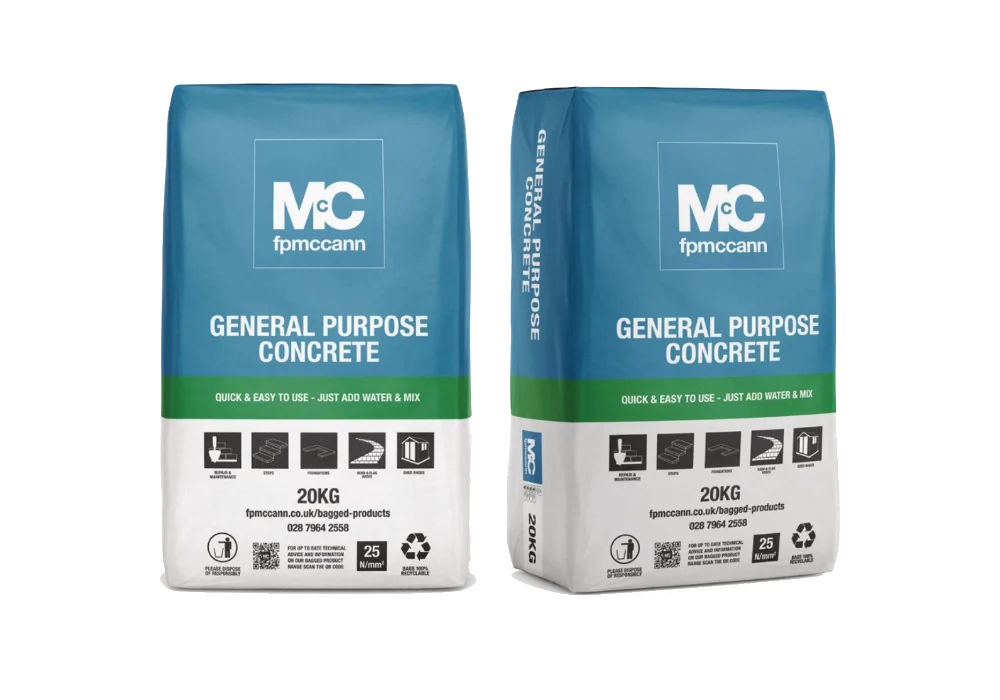
The current information for General Purpose Concrete states an approximate yield of 0.01 m³, or 10 litres, per 20 kg bag. Dividing the example’s 0.225 m³ by 0.01 m³ gives 22.5 bags, so the starting quantity is 23 whole bags before adding an allowance.
|
Stage |
Calculation |
Result |
|
Geometric volume |
2 × 1.5 × 0.075 |
0.225 m³ |
|
Bags before rounding |
0.225 ÷ 0.01 |
22.5 bags |
|
Whole bags before allowance |
Round up |
23 bags |
|
Illustrative 10 percent allowance |
0.225 × 1.10 ÷ 0.01 |
24.75 bags |
|
Whole bags with that allowance |
Round up |
25 bags |
The 10 percent allowance is an illustration, not a universal requirement. Choose an allowance that reflects the actual excavation, handling and risk of running short. Do not count the same allowance twice. At 25 bags of 20 kg, the example also involves 500 kg of dry material to deliver, store and move.
For a product yielding 0.01 m³ per 20 kg bag, approximately 100 bags are needed for 1 m³ before allowances. That represents 2,000 kg of dry material. This answer applies to that declared yield; another 20 kg product can have a different yield.
Use the Concrete Calculator for help with the volume, then use the exact product’s yield for the bag calculation. If the packaging or current product data differs from an earlier estimate, recalculate before ordering.
For a uniform mortar bed, calculate area multiplied by bed depth, then divide by the bedding mortar’s yield. The listed yield for Paving Bedding Mortar is approximately 11 litres per 20 kg bag. Use that product’s yield rather than the 10 litre concrete figure.
For example, 5 m² of bedding at a uniform 40 mm depth requires 0.20 m³, or 200 litres. At an approximate 11 litres per bag, that is 18.18 bags, rounded up to 19 before allowances. Confirm that the bed depth and complete paving build-up meet the project requirements.
Paving Grout coverage depends on joint width, joint depth and the size and layout of the paving units. Patio area alone is not enough to calculate the joint volume. For High Performance Grout, use the specified void dimensions and the yield for the required consistency.
Start with the quantity of bags at the price applicable to your order. Add delivery, mixing equipment or hire, water and power where relevant, labour, movement around site and cleaning. Use the same VAT basis when comparing options.
A simple comparison is: total material cost plus delivery plus equipment plus labour plus other applicable job costs. Where labour matters, multiply the number of people by the hours needed and the applicable hourly cost. Include preparation, loading, transport and finishing, not just time spent at the mixer.
A mixing machine’s output is not the same as completed work. The crew may be limited by bag loading, access, transporting material, placing, compaction or finishing. Short working times can also limit the quantity that can sensibly be prepared at once.
For recurring work, record a trial using the exact product and approved mixing method. Note bag size, bags used, elapsed time, crew size, finished quantity, waste and cleaning time. Those records give you a more useful cost basis than applying a headline machine output to every material.
For larger quantities, also compare a delivered concrete quotation. For repeated mixing work, compare equipment hire or ownership using measured time savings and expected use. Do not assume the mixer, material or labour saving will be identical on every job.
No. Use the product’s declared mixed yield. Equal bag weights do not guarantee equal finished volumes across different materials.
Do not add water beyond the specified range to stretch the material. It can affect performance and does not replace ordering the correct quantity.
Choose from the Bagged Materials range and check the current yield, bag size, price applicable to your account and delivery terms. Contact the team if you need help interpreting the product information for your estimate.
We use essential technologies to make this website work. With your permission, we would also like to measure how people use it and display third-party content. The website will still work if you refuse optional technologies.